Consumption Chronicles: From Sacks to Screens (1975–2026)
The act of purchasing daily sustenance is one of the most fundamental human activities, serving as a direct reflection of economic structure, technological capability, and cultural norms. Over the past half-century, the landscape of grocery shopping has undergone a profound transformation. In 1975, food procurement was an intimate, tactile, and highly localized ritual anchored in neighborhood general stores. Fast forward to 2026, and the retail ecosystem has morphed into an automated, data-driven, hyper-efficient digital landscape. This comprehensive analysis explores the dramatic five-decade evolution of consumer behavior, retail operations, and payment mechanics that redefined how humanity buys its daily bread, sugar, and greens.
1. The Retail Atmosphere of 1975: Tactile, Manual, and Personal
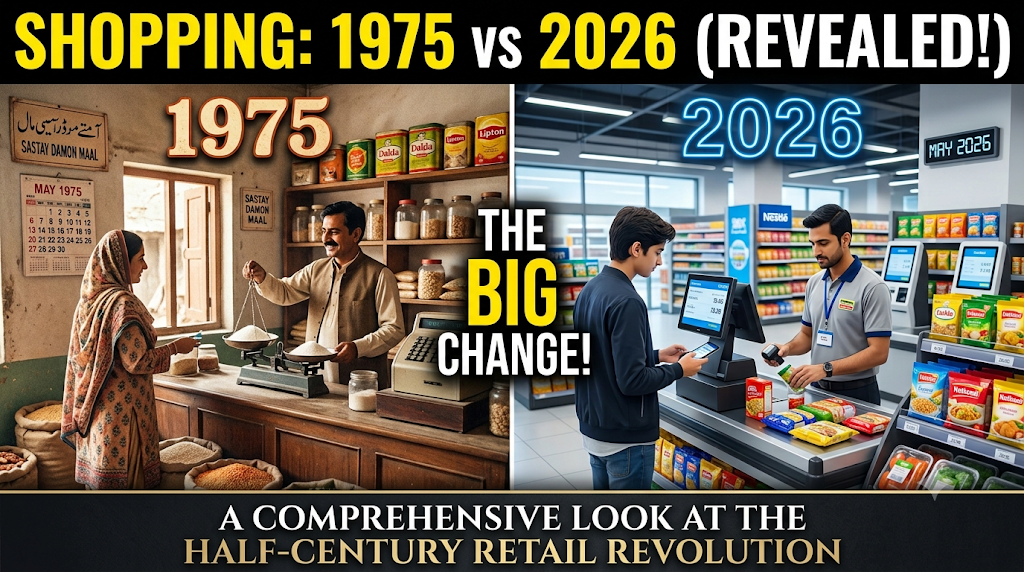
Stepping into a typical neighborhood merchant shop or general store (known in South Asia as a kiryana store) in 1975 was a sensory experience deeply rooted in community ties. The shop structure was counter-service oriented; consumers did not wander through spacious, air-conditioned aisles filling personal carts. Instead, a sturdy wooden counter physically separated the buyer from the inventory. Behind the merchant sat floor-to-ceiling wooden shelving units filled with tin canisters, glass jars, and woven burlap sacks brimming with unrefined sugar, pulses, whole grains, and basic spices.
Measurement was a deliberate art. The shopkeeper operated a brass double-pan balance scale, counterbalancing iron weights against raw produce or dry bulk goods. Sugar, flour, and lentils were scooped out of large jute bags using metal trowels and wrapped directly in brown kraft paper or recycled newsprint tied with cotton twine. Vegetables were acquired daily from open-air municipal stalls or itinerant cart vendors whose inventory depended strictly on seasonal and local agricultural yields.
The Socioeconomic Anchor of the Neighborhood
The 1975 retail dynamic relied on trust rather than algorithms. The store owner acted as an informal credit guarantor for the community, maintaining a handwritten ledger (often a battered leather ledger book) that tracked family accounts on a monthly basis. Payment was cash-driven or settled upon the monthly disbursement of wages. Transaction speed was slow, but the trade-off was unmatched personal relationships, localized product customizability, and deep social cohesion within urban quarters and rural villages alike.
"In 1975, shopping was not merely a financial transaction; it was a daily social check-in where credit was built on character, products were sold in bulk without plastic branding, and the merchant knew every customer's household needs by heart."
2. Mid-Century Retail Infrastructure: The Shift Toward Standardization
The late 1970s and 1980s introduced the early structural precursors of modernized consumerism. The arrival of the Universal Product Code (UPC) and early optical barcode scanners in the mid-1970s marked the first major step away from fully manual price tagging and hand-calculated totals. Standardized packaging quickly gained momentum as consumer goods manufacturers shifted from bulk distribution to branded, pre-packaged retail units.
This period witnessed the gradual emergence of self-service retail formats. Customers gained direct physical access to shelves, selecting packaged biscuits, canned vegetables, and processed cooking oils on their own before presenting them at a central register. While this shift enhanced efficiency and expanded brand options, it systematically reduced direct interpersonal interactions between shoppers and retail staff.
3. The 2026 Retail Ecosystem: Automated, Frictionless, and Connected
By 2026, retail consumer operations operate on principles of maximum velocity, algorithmic personalization, and ambient technological integration. The physical supermarket of today bears little resemblance to the counter-service shops of five decades ago. High-efficiency LED panel illumination, climate-controlled micro-environments, digital shelf tags with dynamic pricing, and automated inventory systems define the modern retail aisle.
Frictionless Payment and Computer Vision
Point-of-sale friction has been almost completely eliminated. In 2026, paper currency and even physical credit cards have largely given way to contactless payment architectures, instant mobile Unified Payments Interfaces (UPI), biometrics, and autonomous camera-based checkout channels. High-resolution overhead sensor arrays and weight-sensing smart shelves instantly detect when a customer picks up a hydroponically grown vegetable tray or a pre-sealed pouch of organic sugar, auto-billing their digital wallet upon exiting the premises.
Supply Chain Transparency and Cold-Chain Logistics
Where produce in 1975 was highly seasonal and regionally constrained, the 2026 supply chain utilizes advanced global cold-chain logistics, IoT-monitored transportation units, and predictive AI inventory models. Fresh berries, exotic vegetables, and specialty grains are available year-round with full farm-to-shelf traceability via QR code verification on eco-friendly, biodegradable vacuum packaging.
4. Comparative Analysis: 1975 vs. 2026
To fully grasp the magnitude of this fifty-one-year shift, we can compare key functional dimensions of the retail experience across both eras:
- Product Packaging & Sourcing: In 1975, goods were predominantly unpackaged, sold in bulk from jute sacks and tin bins, and sourced regionally. In 2026, products are pre-portioned, sealed in sustainable barrier films, and tracked across global supply networks.
- Measuring & Pricing: In 1975, merchant balance scales and manual chalkboards dominated, requiring hand calculations by the store owner. In 2026, digital precision scales, auto-scanning barcodes, and dynamic cloud-updated Electronic Shelf Labels (ESL) automate pricing in real time.
- Payment Mechanisms: In 1975, transactions were settled with physical paper notes, coins, or informal ledger credit (khata). In 2026, payments are processed digitally via smartphones, biometric scans, NFC devices, and instant wallet transfers.
- Customer Journey: In 1975, shoppers stood in front of a counter while a merchant retrieved each item individually. In 2026, shoppers navigate broad self-service aisles or bypass physical stores entirely through 10-minute quick-commerce delivery applications.
5. The Convergence Era: Digitizing the Traditional Merchant
Interestingly, the shift from 1975 to 2026 has not resulted in the complete extinction of traditional independent shops. Instead, a hybrid model has emerged. Millions of small neighborhood stores have modernized their back-end infrastructure. The iconic corner merchant who once weighed sugar on a mechanical scale in 1975 now accepts instant smartphone QR payments, receives wholesale deliveries via B2B e-commerce platforms, and manages inventory through cloud-based mobile POS apps.
Conclusion: A Balance Between Efficiency and Connection
The transition of grocery shopping from 1975 to 2026 illustrates humanity's endless drive toward convenience, speed, and scale. Modern technological integration has eliminated physical strain, optimized global resource distribution, and granted consumers unprecedented variety and food safety guarantees. Yet, looking back at the humble shopfronts of 1975 reminds us of the value of human connection, local trust, and mindful consumption. As the retail sector continues to evolve beyond 2026, the ideal marketplace will be one that combines the hyper-efficiency of the digital age with the warmth and personal trust of the traditional neighborhood shop.