From Clay Pots to Smart Sensors: The Half-Century Transformation of Rural Water Access (1975–2026)
1. Executive Summary & Historical Context
Water access serves as the fundamental barometer of human socio-economic development, health equity, and rural modernization. Across agrarian settlements worldwide, particularly in South Asia and rapidly developing agricultural regions, the methods used to extract, transport, store, and measure drinking water have undergone a revolutionary shift between the years 1975 and 2026.
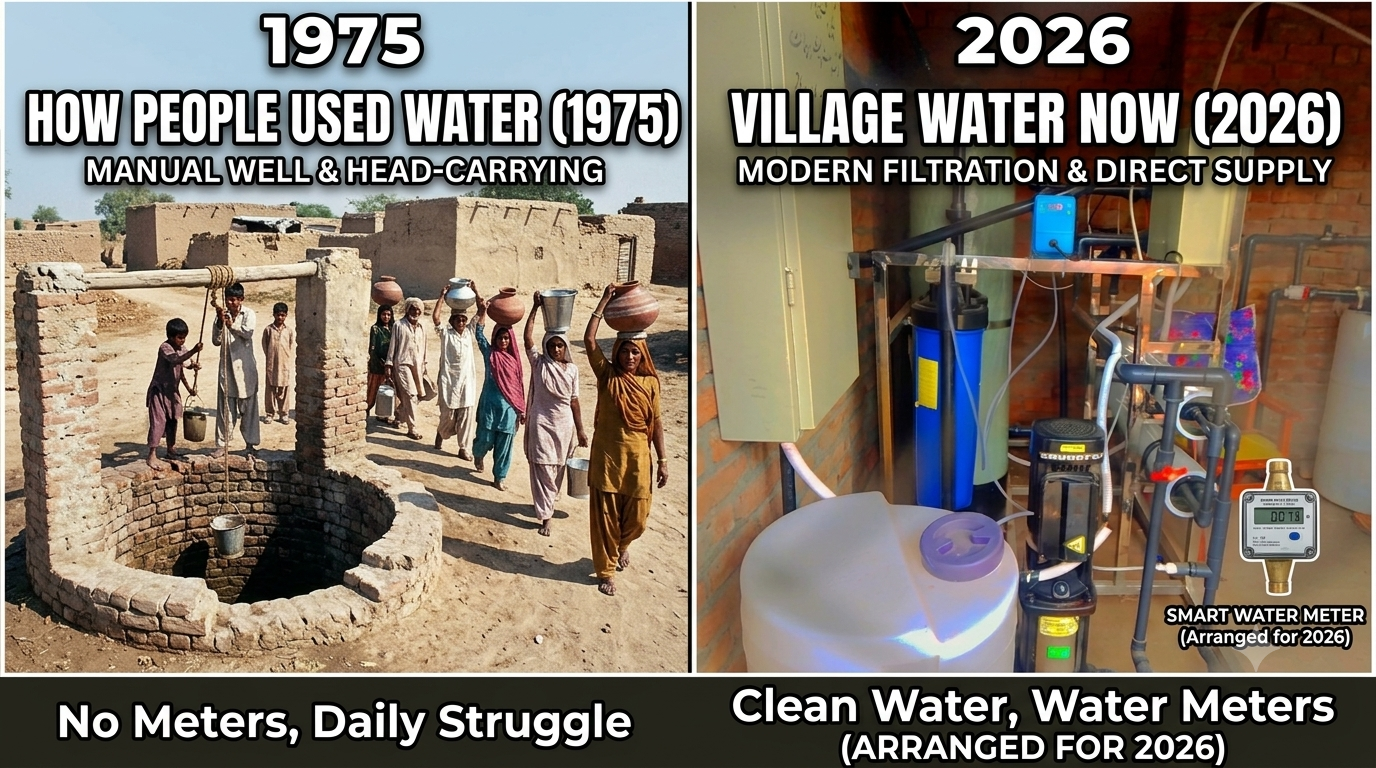
In 1975, the average rural household spent upwards of three to four hours every single day securing untreated water from shallow, open, brick-lined wells or natural surface streams. Physical labor, heavy ceramic head-pots (matkas), manually pulled ropes, and rudimentary wooden pulleys were the sole tools of survival. Fast forward to 2026, and the same rural settlements now utilize commercial-grade reverse osmosis (RO) filtration skids, stainless steel vertical multistage booster pumps, multi-media water softening vessels, and digital smart water meters designed to monitor volumetric consumption in real time.
This comprehensive study documents the structural, mechanical, social, and economic milestones that enabled this 51-year transition. By examining the shifting physical mechanics of water extraction alongside public health metrics and modern digital utility management, we uncover how rural water management transformed from an exhausting daily struggle into an automated, metered, and purified public utility system.
2. The Rural Water Reality of 1975: Manual Labor and Unfiltered Risks
To fully grasp the magnitude of modern technological advancements, one must first analyze the physical, environmental, and structural conditions that defined village life in 1975. During this era, central municipal planning rarely extended past suburban perimeters, leaving remote rural villages to operate entirely off off-grid, unmonitored groundwater sources.
Open Dug Wells (Katcha & Pakka Wells)
The undisputed centerpiece of village life in 1975 was the open dug well. Constructed manually through hazardous digging techniques, these wells ranged from unlined dirt pits (katcha wells) to rudimentary kiln-fired brick cylinders (pakka wells). They typically tapped into topsoil aquifers at shallow depths between 20 and 60 feet.
- Mechanical Mechanics: Drawing water required raw muscle power. Villagers used thick jute or coir ropes tied to zinc-coated iron pails or rubber buckets. Where basic mechanics existed, a wooden or cast-iron pulley wheel (charkhi) was mounted over the well mouth to reduce friction, though it still demanded continuous physical exertion.
- Environmental Vulnerability: Because these well mouths remained wide open to the elements, airborne dust, falling foliage, agricultural runoff, and animal droppings continuously contaminated the water supply. During heavy monsoon seasons, floodwaters washed organic debris and fecal coliform directly into the static water column.
- Seasonal Vulnerability: Shallow groundwater tables fluctuated drastically throughout the seasonal cycle. During summer droughts, wells regularly ran completely dry, forcing entire communities to migrate toward distant riverbanks or muddy surface pits.
The Human Transport Burden: Head-Carrying and Physical Strain
Retrieving water in 1975 was not simply a chore; it was a grueling physical obligation that fell almost exclusively on women and young children. Lacking internal plumbing or pressurized distribution networks, every single drop of water consumed for drinking, cooking, personal hygiene, and livestock had to be physically carried from the water source to the household.
The primary transport vessels were traditional unglazed earthenware clay pots (matkas), brass vessels (gagang), or galvanized tin pails. A standard clay pot filled with water weighs approximately 15 to 20 kilograms. Women routinely balanced two to three stacked pots on their heads while walking several kilometers over uneven, unpaved dirt trails. Over decades, this repetitive physical strain resulted in widespread skeletal issues, severe cervical spine compression, chronic lower back pain, and elevated rates of maternal health complications.
Public Health in 1975: The Waterborne Disease Cycle
Because microbiological water testing was nonexistent in rural regions during the mid-1970s, water contamination was endemic. Pathogens such as Vibrio cholerae, Salmonella enterica, Giardia lamblia, and various rotaviruses spread rapidly through shared open wells. Infant mortality rates linked to acute diarrheal illnesses remained strikingly high, and seasonal outbreaks of typhoid and infectious hepatitis were widely accepted as an unavoidable aspect of village living.
3. The Decades of Infrastructure Evolution (1980–2015)
The movement from primitive manual extraction toward today's digital utility infrastructure progressed through distinct technological and legislative eras. Over four decades, gradual public investments and engineering innovations slowly systematically modernized the rural water landscape.
1980s: The Deep-Set Hand Pump Revolution
Recognizing the public health hazards of open dug wells, governments and international aid organizations initiated global groundwater programs during the 1980s. The breakthrough innovation of this decade was the widespread installation of closed, deep-bore hand pumps (such as the India Mark II and regional variants).
By drilling narrow boreholes 100 to 200 feet deep—far below the polluted shallow topsoil layer—and sealing the surface ground connection with concrete aprons, hand pumps provided rural populations with their first taste of pathogen-free drinking water. The mechanical advantage of leverage handles made pumping significantly easier than hauling ropes up open shafts, drastically decreasing immediate contamination risks.
1990s: Rural Grid Expansion and Early Electric Pumping
As national power grids slowly reached deeper into rural sectors throughout the 1990s, mechanical hand pumping began giving way to electric extraction. Single-phase induction motors and early centrifugal pumps were installed atop existing boreholes.
This period saw the introduction of centralized neighborhood collection taps. Rather than operating a manual lever for 10 minutes to fill a single bucket, villagers could simply turn a brass gate valve attached to a community riser pipe, filling vessels in a fraction of the time.
2000s–2015s: Overhead Reservoirs and Pipe Networks
With reliable electricity becoming standard across rural districts, municipal civil engineers began constructing elevated reinforced concrete overhead tanks (OHSRs) at central village locations. High-capacity submersible pumps lifted raw groundwater into these elevated reservoirs, allowing gravity to push water through subterranean polyvinyl chloride (PVC) pipe networks directly into household yards.
While this period eliminated the physical burden of walking miles for water, raw groundwater was still distributed without complex multi-stage chemical treatment or active volumetric monitoring. Increasing agricultural fertilizer use and industrial expansion during these years slowly contaminated deep aquifers with nitrates, heavy metals, total dissolved solids (TDS), and fluoride, setting the stage for the advanced purification boom of the 2020s.
4. The 2026 Rural Water Standard: Purified, Automated, and Metered
By 2026, rural water management fully entered the modern industrial age. Today’s village water station is no longer a simple hole in the ground or a basic tap point; it is an automated, microprocessor-controlled mini-utility plant engineered to deliver safe, purified, and strictly monitored water directly to rural homes.
Integrated RO & Multi-Stage Filtration Assemblies
Modern 2026 village water treatment plants operate multi-barrier filtration skid systems designed to handle fluctuating feed-water turbidity, elevated TDS levels, and microbial contamination. A typical 2026 installation features several distinct engineering components working in harmony:
- Vertical Multistage Centrifugal Booster Pumps: High-efficiency industrial stainless steel pump assemblies (such as Grundfos CR series skids) supply continuous, stable hydraulic pressure required to force feed-water through semi-permeable membranes.
- High-Capacity Sediment & Micro-Filtration Housings: Large-diameter polypropylene melt-blown and spun sediment filters trap suspended solids, sand grains, rust flakes, and micro-particulates down to 5 microns before water reaches sensitive membrane stages.
- Fiberglass Reinforced Plastic (FRP) Media Vessels: Tall FRP pressure tanks loaded with graded quartz silica sand, activated granular carbon, and ion-exchange softening resins act as pre-treatment filters. They effectively strip organic compounds, eliminate unpleasant odors, neutralize excess iron, and lower calcium hardness.
- Reverse Osmosis (RO) Membrane Matrix: Thin-film composite (TFC) industrial RO membranes remove up to 99% of dissolved inorganic salts, heavy metals (such as arsenic and lead), microplastics, and viral pathogens, delivering crystal-clear drinking water.
- Automated Backwash and CIP Systems: Microprocessor-controlled multi-port control valves automatically initiate periodic backwashing and Clean-In-Place (CIP) chemical flushing routines during off-peak hours to prevent bio-fouling and extend membrane lifespan.
Digital Smart Water Meters and Distribution Equity
Perhaps the most significant policy and engineering shift visible in 2026 is the universal adoption of digital smart water meters. Historically, unmetered rural water connections suffered from massive volume waste, illegal pipe tapping, unrecorded leakage, and inequitable distribution where homes near the main header overused water while homes at the pipeline ends received dry taps.
The 2026 smart metering infrastructure resolves these systemic issues through advanced instrumentation:
- Volumetric Flow Measurement: Digital pulse-emitting flow meters track continuous throughput, displaying accurate digital readings of cumulative consumption down to fractions of a liter.
- Real-Time Data Transmission: Integrated cellular IoT (Internet of Things) or LoRaWAN communication modules send automated flow rate data directly to village water management dashboards and municipal utility servers.
- Leak and Burst Detection: Algorithmic monitoring compares upstream plant output against cumulative downstream household meter logs. Sudden pressure drops or unexpected continuous flow signatures trigger automated alerts to maintenance technicians, identifying underground pipe breaches within hours.
- Prepaid Smart Card & Mobile Payment Interfaces: Modern automated water dispensing kiosks (water ATMs) allow residents to tap RFID smart cards or scan mobile wallet codes to retrieve precise quantities of purified drinking water, ensuring full financial transparency and supporting long-term operations and maintenance (O&M) funds.
5. Comprehensive Engineering Comparison: 1975 vs. 2026
The following detailed technical matrix contrasts the foundational operational, structural, and social attributes of village water access across both eras:
| Evaluation Parameter | 1975 Village Water Standard | 2026 Village Water Standard |
|---|---|---|
| Primary Source | Shallow open dug wells, surface rivers, seasonal ponds | Deep borewells integrated with high-yield aquifer taps |
| Extraction Mechanism | Manual physical pulling, jute rope, wooden pulleys (charkhi) | Stainless steel vertical multistage electric pumps & submersible skids |
| Purification Technology | None; occasional manual cloth straining or natural settling | Multi-stage filtration: Sediment, Granular Activated Carbon, Softeners, RO |
| Water Quality Monitoring | Visual inspection (clarity and smell only); no lab testing | Digital inline TDS sensors, automated pH sensors, microbial lab testing |
| Transport Method | Manual head-carrying using clay pots (matkas) over miles | Pressurized underground HDPE/uPVC pipe networks directly to taps |
| Consumption Tracking | Completely unmetered; limited by human physical carrying capacity | Digital smart water meters, volumetric pulse registers, RFID kiosks |
| Daily Labor Burden | 3 to 4 hours per day expended by women and children | Zero physical transit labor; instant automated household availability |
| System Reliability | Highly vulnerable to drought, seasonal water table drop, contamination | Continuous supply backed by storage reservoirs, automated backwash, smart monitoring |
| Prevalent Health Risks | Cholera, dysentery, typhoid, chronic cervical and spinal strain | Virtually zero microbial risks; balanced mineral content post-filtration |
| Governance Model | Informal, unmonitored community access at well sites | Digital utility management, metered tariffs, scheduled preventive maintenance |
6. Broad Socio-Economic and Demographic Transformations
The shift from manual water hauling to automated, metered distribution has catalyzed profound socio-economic shifts across rural societies, transforming daily economics, gender roles, public health costs, and environmental management.
1. Educational Equity and Gender Empowerment
In 1975, the burden of collecting water acted as a primary structural barrier preventing young girls from attending school. The hours spent walking to wells and waiting in queues directly overlapped with school instruction times. Eliminating physical water hauling has dramatically increased primary and secondary school completion rates among rural female students, laying the foundation for higher literacy and diverse economic opportunities.
2. Rural Health Economics and Reduced Medical Debt
Waterborne diseases historically acted as a primary driver of crippling healthcare debt among rural farming families. Frequent bouts of dysentery or typhoid forced breadwinners to miss crucial harvest seasons while spending scarce income on emergency medical care. The deployment of clean, filtered water infrastructure has permanently flattened infection curves, freeing up household disposable income for education, farm mechanization, and housing improvements.
3. Aquifer Conservation Through Smart Tariff Structures
Unregulated groundwater extraction led to severe water table depletion during the early 2000s. The introduction of digital smart meters in 2026 has established a sustainable framework for aquifer conservation. By charging small, equitable, volume-based fees for non-essential heavy consumption while providing guaranteed free baselines for basic human survival, rural water boards successfully disincentivize water waste, ensuring groundwater sustainability for future generations.
7. Conclusion & Future Outlook
Looking back across the 51-year span from 1975 to 2026, the transformation of village water access represents one of modern civil engineering's greatest success stories. What began as an exhausting, hazardous manual chore defined by clay pots, deep open holes, and constant illness risks has evolved into an automated, highly scientific, digital public utility system.
The modern 2026 village water station—equipped with high-pressure booster pumps, multi-stage filtration vessels, RO membrane filtration skids, and IoT smart water meters—stands as a monument to human ingenuity and social progress. By ensuring that drinking water is clean, accessible, equitable, and accurately measured, rural communities have broken free from historical survival cycles, unlocking unprecedented potential for health, economic prosperity, and sustainable development.