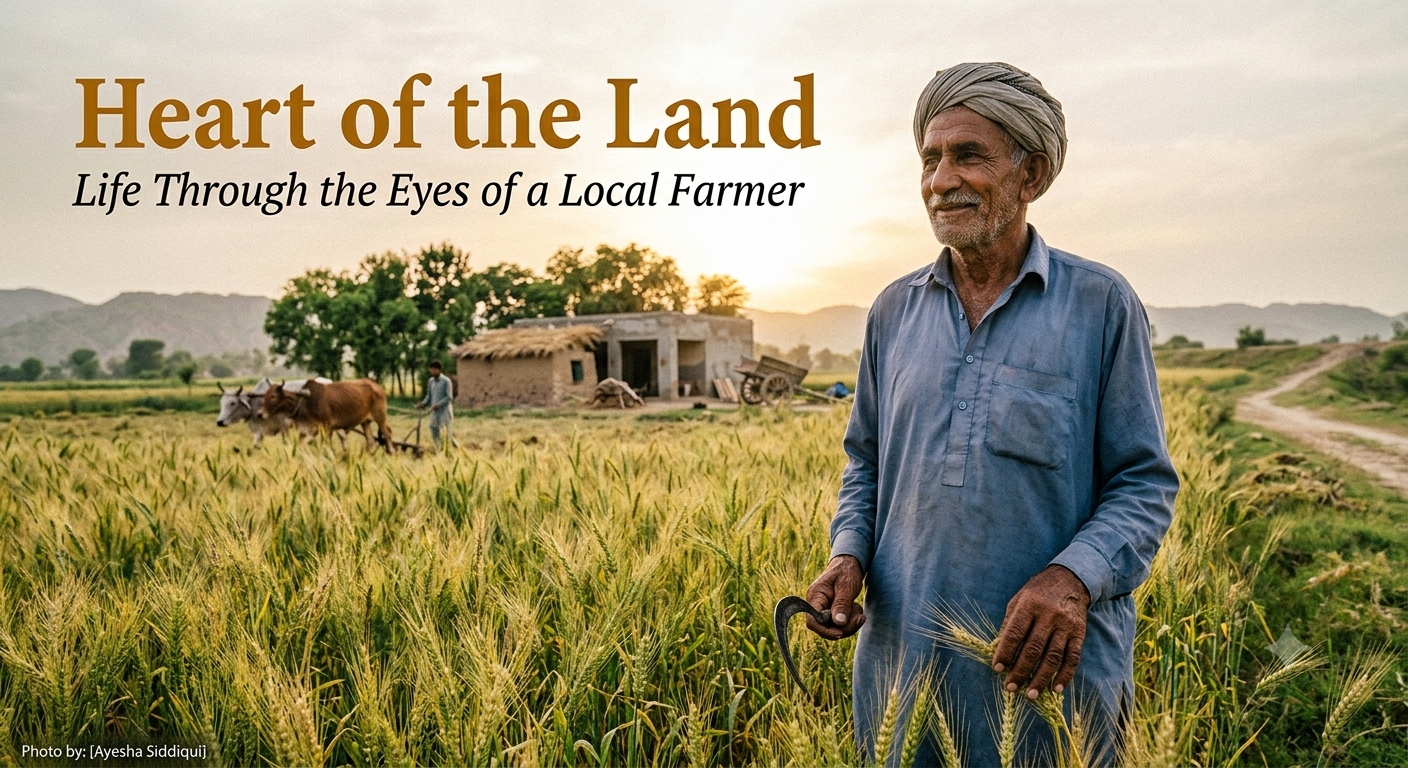
Heart of the Land: Life Through the Eyes of a Local Farmer
An in-depth exploration into the rhythm, reality, resilience, and quiet triumph of the village farmer—the unsung hero sustaining human civilization from the ground up.
Introduction: The Silent Architects of Survival
Long before the first golden light of dawn breaks over the rural horizon, a quiet revolution takes place every single morning. While urban metropolises sleep under the soft hum of electricity and air conditioning, the heartland of the world stirs in darkness. The village farmer—known in many cultures simply as the kisan or the worker of the soil—is already on their feet. There are no alarm clocks needed when your internal clock is attuned to the crowing of roosters, the shifting winds, and the cold, crisp morning air that signals the start of another grueling day.
In modern discourse, we often speak of technological marvels, artificial intelligence, finance, and industrial expansion as the pillars of human progress. Yet, beneath every mega-city, every high-rise office, and every bustling digital network lies an ancient, non-negotiable reality: human beings must eat. Food is the fundamental currency of existence, and the entire edifice of modern civilization is built directly upon the shoulders of the rural farmer. Without their relentless labor, the gears of world commerce, art, science, and governance would grind to an absolute halt in a matter of days.
Yet, despite carrying the immense weight of national food security, the life of a village farmer remains largely unseen, misunderstood, or romanticized from a distance. To city dwellers, rural agriculture is often reduced to picturesque landscapes—rolling green fields, golden wheat swaying in the breeze, and picturesque sunsets. But to see the world truly through the eyes of a local farmer is to look past the pastoral aesthetics and confront a life defined by sheer physical stamina, emotional fortitude, razor-thin economic margins, and a deep, spiritual bond with nature. This article takes a deep journey into the heart of the land, detailing the everyday reality, seasonal triumphs, systemic struggles, and enduring legacy of the local farmer.
1. The Rhythm of Dawn: A Day in the Life
To understand the local farmer, one must first step into their daily routine. Life in the village does not operate on a rigid 9-to-5 schedule; it operates on the schedule of the sun, the livestock, and the moisture of the soil. A single day in the fields demands a multi-faceted discipline that tests both mind and body.
The Pre-Dawn Wakeup and Preparation
The daily cycle typically starts around 4:00 AM. Before setting foot in the main crops, the farmer’s immediate concern is domestic animal husbandry. Cattle, buffaloes, oxen, or goats—the quiet partners of the farm—must be fed, watered, and cleaned. Milking must happen early so that raw dairy can be consumed locally or collected by local distribution networks before the heat of the day spoils it. Once the livestock is tended to, a quick, humble breakfast and a hot cup of tea provide the necessary fuel for hours of uninterrupted manual labor.
Tending to the Field
By 5:30 AM, as twilight softens the sky, the farmer reaches the fields. Walking along narrow mud embankments (known locally as banns or bunds), they visually inspect every section of their land. A farmer’s eyes are uniquely trained; they do not just see plants, they read them like an open book:
- Color and Texture: Subtle yellowing at the tip of a leaf indicates a nitrogen deficiency or overwatering.
- Soil Moisture: A quick pinch of topsoil between two fingers tells the farmer whether irrigation can wait another 24 hours or must happen immediately.
- Pest Activity: The presence of specific insects under leaf undersides signals an early infestation that must be addressed before destroying an entire crop cycle.
The morning hours are dedicated to the heaviest physical chores. Depending on the season, this could mean guiding a heavy diesel tractor or behind-hand plows across dense clay, manually digging irrigation trenches, clearing aggressive weeds with a handheld sickle (daranti), or applying organic and chemical nutrients. Laboring early minimizes the risk of heat exhaustion, particularly in regions where summer temperatures routinely exceed 40°C (104°F).
Midday Pause and Evening Chores
When the sun reaches its zenith and the heat grows oppressive, work slows down. The afternoon is traditionally reserved for repair, maintenance, and community interactions. A farmer is not merely an agronomist; they are an amateur mechanic, a plumber, a carpenter, and a meteorologist. Midday break is often spent under the shade of a large Banyan or Neem tree, fixing a clogged pump motor, sharpening rusted tool blades, or discussing grain prices with neighboring villagers at a community gathering spot.
As the sun begins its descent, physical field activities resume. Late afternoons are prime times for harvesting mature produce, bundling fodder for cattle, and ensuring that irrigation waters are flowing correctly through complex channels. Work rarely concludes until sunset forces a natural end to the day. Returning home covered in dust and sweat, the farmer's evening is spent with family, sharing simple home-cooked meals, and preparing mentally for the exact same routine tomorrow.
2. The Four Pillars of the Agricultural Calendar
While an urban worker measures time in business quarters or fiscal years, a village farmer measures life in agricultural seasons. The year is broken into distinct phases, each carrying its own unique emotional tone, operational demands, and financial risk.
| Seasonal Phase | Primary Activities | Key Challenges | Dominant Emotion |
|---|---|---|---|
| 1. Soil Preparation (Pre-Sowing) | Plowing, leveling, deep-tilling, fertilizing, canal clearing. | High upfront cost for fuel, soil degradation, hard physical labor. | Anticipation & Grounding |
| 2. Sowing & Planting | Seed selection, nursery transplantation, setting precision rows. | Timely availability of quality seeds, initial pest management. | Hope & Optimism |
| 3. Crop Maintenance | Irrigation management, weeding, applying fertilizers/pesticides. | Extreme weather risks, water scarcity, heatwaves/droughts. | Anxiety & Vigilance |
| 4. Harvesting & Market Sale | Cutting, threshing, bundling, transportation, trading at markets. | Post-harvest loss, unfair middleman pricing, volatile market rates. | Relief & Exhaustion |
Soil Preparation: The Foundation
Long before a single seed is dropped into the earth, the ground must be prepared like an artist prepares a canvas. If the soil is too compact, roots cannot breathe or extend depth; if it lacks organic nutrients, young saplings will wither early. Soil preparation requires breaking hard earth, turning over nutrient-rich deep layers, and mixing in manure or compost. It is expensive, time-consuming work that must be completed within narrow windows of weather opportunity.
Sowing: The Act of Ultimate Faith
There is perhaps no human action that requires more pure faith than sowing a crop. A farmer spends thousands of units of local currency on high-yield seeds, buries them inches beneath the surface, and effectively leaves their investments to the elements. During sowing season, entire village communities work in collective harmony, often helping each other transplant paddy seedlings into flooded fields or drill wheat seeds into neatly furrowed lines.
Maintenance: The Long Wait
Between sowing and harvesting lie months of agonizing vigilance. It is during this period that crops are most vulnerable to nature. The farmer becomes a full-time guardian. A sudden shift in wind direction might bring a swarm of destructive locusts; a week-long heatwave can dry out shallow roots; unseasonal hail can strip fruit off branches in minutes. The psychological toll of crop maintenance is immense, as months of future income sit exposed outdoors, completely vulnerable to forces beyond human control.
Harvesting: The Culmination of Labor
Harvest season is the dramatic climax of the agricultural year. Fields transform into vibrant landscapes of gold, yellow, and deep green. The atmosphere in the village shifts from quiet tension to bustling, frantic energy. Harvesting is a race against time: if crops remain in the field too long after reaching maturity, they shatter, dry out, or rot from morning dew. Modern combine harvesters have speeded up this process for larger fields, but millions of smallholder farmers still rely on hand-sickles, laboring in groups to cut, tie, and transport tons of produce by hand or bullock cart.
3. Living at the Mercy of Nature: Climate & Volatility
To fully grasp the reality of a farmer’s life, one must acknowledge that agriculture is the world’s ultimate gamble. Unlike a factory floor, where inputs and production environments are strictly controlled, a farm operates under an open sky.
Climate Change and Unpredictable Weather Patterns
Historically, farmers relied on traditional wisdom, indigenous calendar systems, and astronomical observations handed down across centuries to predict monsoons and frost cycles. Today, global climate change has rendered many of these centuries-old rules obsolete. Monsoon patterns have become erratic—delivering weeks of drought followed by single days of torrential, flood-inducing rainfall. High-frequency heatwaves strike right as delicate crops enter their grain-filling stage, causing yields to drop dramatically.
When a natural disaster strikes an urban business, insurance systems, backup power generators, or remote work capabilities often buffer the impact. When an unseasonal hailstorm strikes a farm three days before harvest, a year’s worth of family income, food supply, and capital investment vanishes into thin air within thirty minutes. This perpetual exposure to catastrophe creates a unique form of chronic psychological stress that rural agricultural communities carry every day of their lives.
The Threat of Water Scarcity
Water is the blood of the land, yet freshwater resources across agricultural belts are diminishing rapidly. Deep groundwater tables are depleting due to over-extraction, forcing smallholder farmers to drill deeper and deeper tubewells at astronomical costs. In canal-fed systems, tail-end farmers often face water shortages due to inefficient distribution, leaving their crops parched while upper-segment fields overflow. Managing every drop of water requires complex scheduling, intense physical labor during night-time irrigation turns, and constant financial expenditure on diesel fuel or electrical power for pumps.
4. The Economics of the Field: Struggles Behind the Harvest
There is a tragic irony at the heart of global agriculture: those who produce the food that sustains human life are frequently among the most economically vulnerable citizens in society. Understanding the local farmer requires an honest look at the structural and economic challenges that keep farm families trapped in cycles of debt.
The Smallholder Reality: Globally, over 80% of the world’s farms are smaller than two hectares (approx. 5 acres). These smallholder family farms produce a vast majority of the world's food supply, yet operate with virtually no safety net against market crashes, crop failures, or inflation.
Input Costs vs. Market Value
Over the last few decades, the cost of farming inputs—high-yield seeds, synthetic fertilizers, specialized pesticides, diesel fuel, machine rentals, and labor—has skyrocketed. However, the wholesale prices that farmers receive for their raw produce have not grown at a matching pace. When a consumer buys a loaf of bread or a bag of vegetables at a sleek city supermarket, only a tiny fraction of that final retail price actually trickles back to the farmer who cultivated the raw ingredients.
The Role of Middlemen and Market Vulnerability
Because raw agricultural produce is highly perishable, farmers rarely have the luxury of holding onto their harvest until market prices improve. They must sell immediately upon harvesting. This urgency gives immense leverage to intermediaries, commission agents, and wholesale market traders (often operating in traditional mandis). Without direct, friction-free access to consumers or cold storage facilities, village farmers are routinely forced to accept whatever bottom-tier prices local buyers dictate on harvest day.
The Debt Trap and Financial Insecurity
To fund the heavy upfront expenses of soil preparation, seed buying, and seasonal irrigation, smallholder farmers often must borrow money before the season starts. When formal banking services are inaccessible or burdened by bureaucratic red tape, farmers turn to informal local moneylenders who charge exorbitant interest rates. A single failed crop cycle due to drought or disease can quickly spiral into compound debt, forcing families to mortgage land, sell livestock, or take on secondary manual labor to survive.
5. Modernity at the Crossroads: Tradition Meets Innovation
Despite these daunting challenges, the story of the village farmer is not merely one of struggle; it is fundamentally a story of adaptiveness, ingenuity, and profound resilience. Rural agriculture is undergoing a quiet technological transformation, creating a fascinating bridge between ancient wisdom and 21st-century innovation.
Preserving Generational Knowledge
Modern science is increasingly validating the traditional agricultural methods developed by local farmers over centuries. Techniques such as crop rotation, natural intercropping (planting mutually supportive crops together), natural composting, and indigenous seed preservation are now recognized as essential components of sustainable agriculture. Farmers hold an intimate, localized knowledge of micro-climates, soil fauna, and biodiversity that no computer algorithm can completely replace.
The Rise of Smart Farming and Agri-Tech
At the same time, young, tech-savvy farmers are embracing modern tools to make their operations cleaner, smarter, and more profitable. Across rural areas, we see a dramatic shift toward technology integration:
- Smartphone Connectivity: Farmers use mobile apps to check real-time satellite weather forecasts, monitor daily wholesale commodity market rates across multiple cities, and diagnose crop diseases instantaneously using AI-driven leaf scan software.
- Solar-Powered Irrigation: Replacing expensive, polluting diesel generators with solar-powered water pumps has significantly reduced daily operating costs and guaranteed reliable water access during daytime hours.
- Drip Irrigation & Precision Farming: Micro-drip systems deliver water and liquid nutrients directly to the plant root zone, reducing water waste by up to 60% while dramatically improving crop yields.
- Direct-to-Consumer Digital Platforms: Emerging e-commerce platforms and farmer-producer organizations (FPOs) allow rural communities to bypass exploitative intermediaries, shipping organic produce straight to urban households and cooperative stores.
6. The Social and Cultural Fabric of Village Farming
Agriculture is not merely a financial operation; it is the binding glue of rural culture, social structures, and family life. In a village setting, a farm is rarely managed by an individual; it is sustained by an entire household and supported by an interconnected community.
The Role of Women in Agriculture
Women are the uncredited engines of rural agricultural economies. From selecting seeds, transplanting crops, and weeding fields to managing livestock, processing harvests, and preparing daily food for field workers, rural women perform an immense share of agricultural work. Recognizing and empowering women farmers with land ownership, financial credit, and technical training remains one of the single most effective ways to boost global agricultural productivity and eliminate rural poverty.
Community Harmony and Mutual Aid
One of the most beautiful aspects of village life is the spirit of collective action—often referred to as Sanjha or community cooperation. When heavy rains threaten an unharvested field, neighbors do not stand by watching; they rush into each other’s fields with sickles to help save the crop. Major agricultural milestones—such as the arrival of spring monsoons or the end of a massive harvest—are celebrated together through vibrant local festivals, folk music, traditional dances, and community feasts. The connection between human social life and the land remains unbroken in the countryside.
7. How Society Can Support the Local Farmer
Understanding the value of the village farmer is only the first step. If society wishes to build a sustainable, food-secure future, active steps must be taken by urban consumers, policymakers, and private institutions to honor and support rural agricultural communities.
- Support Local and Direct Supply Chains: Whenever possible, purchase produce from local farmers' markets, farm cooperatives, or direct-from-farm subscription services. Buying directly ensures that a larger portion of your spending goes straight into the farmer's pocket.
- Advocate for Fair Agricultural Policy: Support public policies that prioritize fair minimum support prices, accessible institutional credit, crop insurance subsidies, and infrastructure investments in rural cold-storage facilities and transport links.
- Reduce Food Waste: Wasting food is not just a financial or ecological issue; it disrespects the months of hard work, water, fertilizer, and human sweat invested by a farmer to grow that food. Mindful consumption in urban homes directly reduces strain on the global food system.
- Bridge the Urban-Rural Divide: Education systems should teach children where their food actually comes from, fostering empathy, respect, and deep appreciation for rural farming communities from an early age.
Conclusion: The Soul of the Earth
As the evening sun sets behind the green fields, painting the sky in deep hues of orange and crimson, the village farmer completes their final rounds for the day. Their hands are rough, calloused, and deeply stained with dark earth—hands that have spent a lifetime tilling, planting, weeding, and reaping. Their face carries the fine lines of a thousand sunny afternoons and sleepless, watchful nights.
Yet, in those tired eyes, there is an unmistakable dignity. It is the dignity of a human being who knows, without a shadow of a doubt, that their labor matters. They do not work for corporate applause or digital likes; they work so that humanity can live, grow, and dream for another generation.
The local farmer is not just a worker in an open field; they are the true heart of the land, the quiet guardian of life, and the unsung pillar of our collective existence. The next time we sit down at a dinner table and enjoy a meal, let us pause for a moment of quiet gratitude for the unseen hands in a distant village who made that meal possible.