The Dawn of Settlement: How Early Farmers Built the First Villages
An in-depth exploration into the Neolithic Revolution, the birth of agriculture, and how ancient humans transitioned from nomadic foragers to village founders.
For over 99% of human history, Homo sapiens lived without a permanent address. Our ancestors were nomadic hunter-gatherers, moving constantly across vast landscapes to follow wild game herds, forage seasonal vegetation, and set up temporary shelters wherever immediate resources allowed. Life was defined by motion, daily survival, and constant adaptation to nature's unpredictable climate shifts.
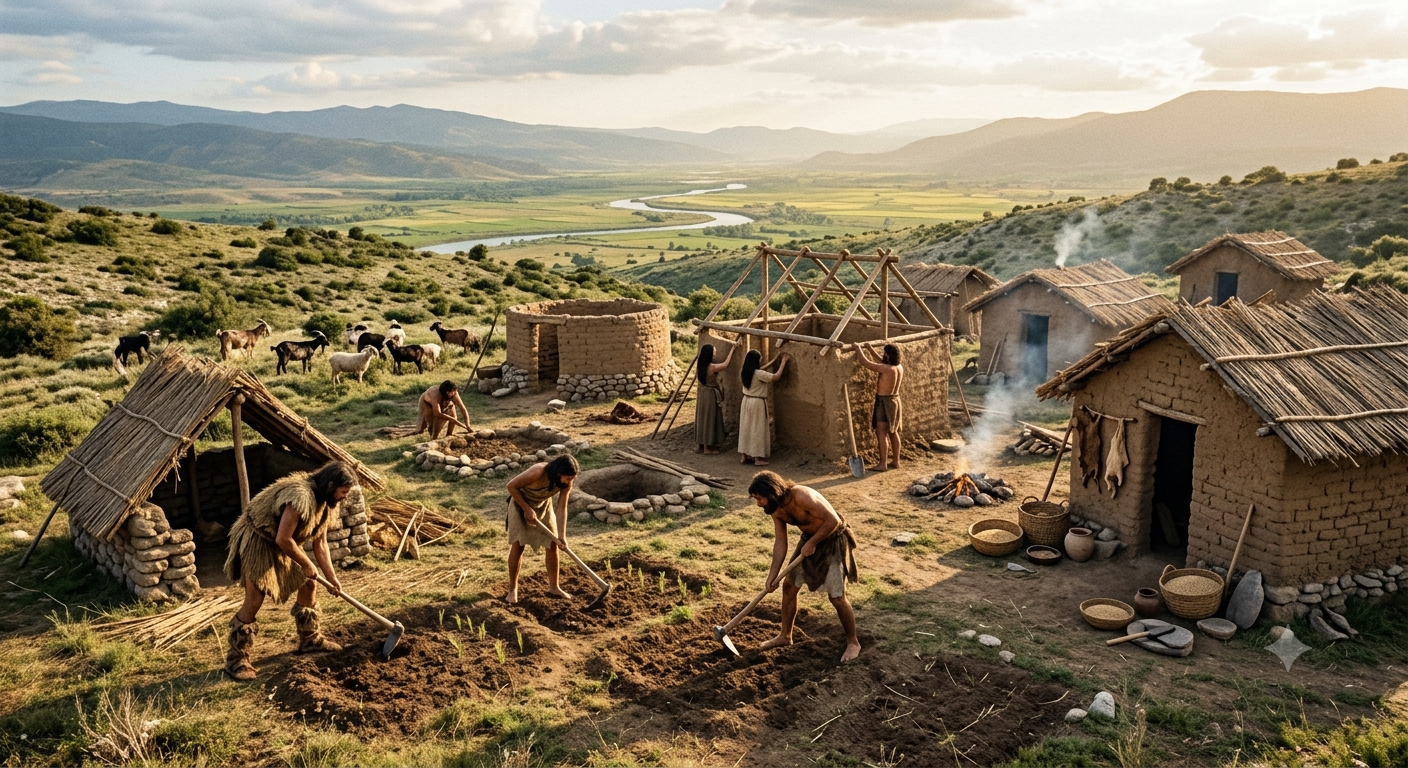
Then, roughly 12,000 years ago, during a pivotal historical era known as the Neolithic Revolution, human life underwent a fundamental and permanent shift. People began to systematically clear land, sow wild seeds, domesticate animals, and construct durable stone and mud-brick structures. This transition transformed small, wandering bands of humans into permanent, self-sustaining village communities.
But how exactly did the very first village start? Which legendary farmer planted the initial seed, and how did a simple patch of cultivated earth lay the foundation for modern urban civilization?
1. The Myth of the "Single Founder"
When studying major human breakthroughs, we often look for a single hero or inventor—an Edison, a Ford, or a Gutenberg. Naturally, readers frequently ask: Which individual farmer started the first village?
Modern archaeological evidence reveals that no single visionary invented agriculture or established the world's first settlement. Instead, the birth of the village was a slow-motion, collective breakthrough that unfolded independently across multiple global hotspots over thousands of years:
- The Fertile Crescent: Spanning modern-day Iraq, Syria, Jordan, Palestine, Israel, and southern Turkey.
- The Yangtze and Yellow River Valleys: Located in ancient China (focused on rice and millet farming).
- Mesoamerica: Modern Mexico and Central America (focused on maize, beans, and squash).
- The Andean Region: South America (focused on potatoes and quinoa).
Rather than a single founder, the "first farmer" was an entire generation of hunter-gatherers—predominantly women who gathered wild grains—who gradually recognized that dropped seeds germinated into harvestable crops near their seasonal camps.
2. Why Humans Gave Up the Nomadic Life
Nomadic hunting and gathering was effective for hundreds of thousands of years. Farming, by contrast, required long hours of heavy clearing, manual weeding, harvesting, and defending land. Why did early humans make the switch?
Climate Shift at the End of the Ice Age
Around 10,000 BCE, global temperatures warmed as the last glacial period ended. Increased rainfall gave rise to rich ecosystems overflowing with wild grains like emmer wheat, einkorn, and barley. Foragers found regions so abundant that year-round migration became unnecessary.
The Population Trap
As nomadic groups camped near abundant wild grain fields for extended periods, their lifestyles became less strenuous. Better nutrition led to shorter birth intervals and higher survival rates. Soon, population density outgrew what wild foraging could support. To feed their growing families, communities had to actively cultivate seeds and domesticate livestock.
| Era / Stage | Primary Food Source | Mobility | Social Structure |
|---|---|---|---|
| Paleolithic Age | Hunting wild game, gathering roots & fruits | Fully Nomadic | Small mobile bands (20–50 people) |
| Mesolithic Transition | Seasonal foraging, fishing, small game | Semi-Nomadic | Seasonal, recurring base camps |
| Neolithic Era | Cultivated crops, domesticated livestock | Permanent Settlements | Villages & Proto-cities (100–5,000+ people) |
3. Step-by-Step: How a Village Was Built
- Plant Domestication: Wild grains shatter easily, dropping seeds before humans can harvest them. Early foragers selectively gathered seeds from rare plant mutations that retained their grain heads. Planting these selected seeds season after season produced domesticated crops tailored for agriculture.
- Animal Domestication: Rather than tracking wild herds over vast distances, early farmers captured, tamed, and bred species such as sheep, goats, pigs, and cattle. This provided a consistent, nearby source of meat, milk, hide, and wool.
- Storage Architecture: Large harvests required durable infrastructure. Farmers built mud-brick houses with raised floors, woven baskets, and stone silos to store surplus grain safely away from moisture and pests.
- Community Defense & Organization: Accumulated food stores attracted neighboring nomadic raiders. To protect their crops, villagers constructed adjoining houses, centralized perimeter walls, and shared water management systems, forging the world's first formal municipal governance.
4. Archaeological Milestones: Early Villages to Urban Centers
Archaeological digs provide direct insight into early human settlements:
- Jericho (West Bank): Dated back to roughly 8,500–8,000 BCE, Jericho is among the oldest continuously inhabited settlements, featuring massive stone walls and watchtowers built to defend its spring-fed agriculture.
- Çatalhöyük (Turkey): Flourishing around 7,000 BCE, Çatalhöyük housed up to 6,000 residents in dense mud-brick homes built wall-to-wall. With no streets, inhabitants traversed the village via flat rooftops and entered homes through ceiling ladders.
- Ur (Sumer / Modern Iraq): Emerging later around 3,800 BCE, Ur evolved from early agricultural roots into a powerful Sumerian city-state. Known for its massive Ziggurat temples, sophisticated legal structures, international trade networks, and cultural artifacts like the Royal Game of Ur, it represents the full evolution from simple farming village to complex urban civilization.
5. The Lasting Legacy of the First Farmers
The establishment of permanent villages set off a chain reaction that continues to define human civilization today:
- Specialization of Labor: Agricultural surpluses meant not everyone had to farm. Communities fostered specialized artisans, weavers, potters, builders, and blacksmiths.
- Governance & Written Language: Managing grain supplies, land distribution, and trade agreements necessitated record-keeping, leading directly to the invention of early writing systems (such as cuneiform) and formal law codes.
- Urbanization: Farming villages laid the structural groundwork for towns, sprawling city-states, and modern metropolitan empires.